
Tsavo West National Park

Updated: Jun 24
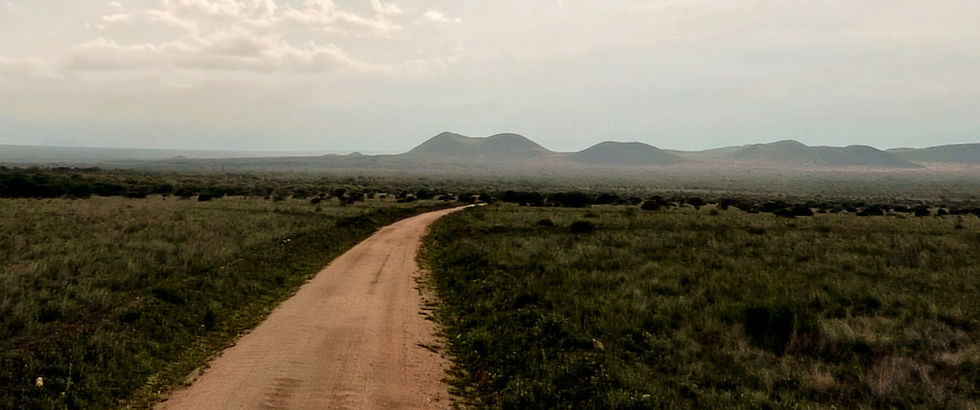
The first thing Tsavo West National Park does is strip you down to size, aft er which it reveals itself: big sekies and layered landscapes, rust-red earth and lava flows to lush springs and green… set against the rise of the Chyulu and Taita Hills, the distant mass of Kilimanjaro, the Ngulia Range, and the far-off Yatta Plateau. Shaped by volcanic eruptions, erosion, and underground aquifers, it’s an amazing park where landscapes, wildlife, and wonderment run without limit. I love it.
Miles and I left Nairobi with the usual road-trip optimism. In front of us was a seven-day safari that would bridge 2025 with the new year, from Tsavo West for two nights, a New Years festival in Voi, then Lake Jipe and a swim in Lake Chala, and two more nights in Amboseli. In sum, roughly 1,500+ kms of tracks, water and basaltic lava. For my ten-year old, Tsavo would be his first bush camp outside with wire in the true Kenyan wild.

By mid-afternoon we rolled through the Mtito Andei Gate and into a haze of red dust. Unlike Amboseli, Nairobi and many other Kenyan parks, Tsavo West isn’t a gentle introduction (nor immediately photogenic from this entry point) but it soon becomes a marvel geologic mix of volcanic hills, ancient lava flows, rugged escarpments and savanna plains, laid over fractured bedrock and groundwater-fed systems. Tsavo, quite starkly, doesn’t cater to its visitors, but to an abundance of uncrowded and thriving wildlife: the big five, leopards and cheetahs, too, hyenas, giraffe, zebra, elands, impalas, and more... and hundreds of bird species including sandgrouses, bustards, cuckoos, nightjars, swifts, and seemingly limitless numbers of red-billed hornbills. Importantly for the visitor, it’s a place where spontaneous detours from the map don’t become mere footnotes to a story, but rather are the story.
Tsavo West stretches more than 9,000 square kilometres, an area slightly smaller than Lebanon and nearly the size of Cyprus (9,250 km²) – in two days we crossed only a small slice of it – most of its lava fields, river systems, and remote plains remained beyond our reach. Thus, it’s a park that can’t be absorbed in a single visit... so we plan another in the heart of the dry season, June/September, when all is in a different seasonal mode.

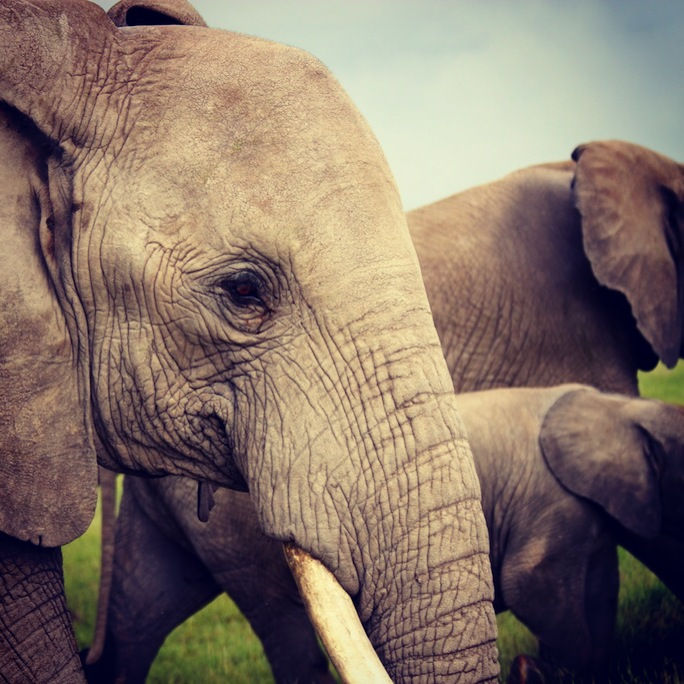
After dumping some gear and setting up camp at the Komboyo campsite, the ol’ Defender rattled westward along the Chyulu Circuit route on the park’s northern boundary, in search of the Chyulu campsite to scout it out for the next day’s camp. We did so with some indifference to finding it, which we didn’t do until the next day, and deliberately side-tracked ourselves onto a wandering, unmarked route. What we found would prove to be our most intimate exchange with elephants over the next seven days: two bull elephants on a forested track that I’d be challenged to find a second time.

One of those two bulls was slightly irritable and not entirely in jive-step with our arrival – a nightclub bouncer in daylight, so was its signalling. The other was calm and disinterested, a slow eating, ambling giant whose untroubled demeanor settled his juddery companion.

Upon first sight, Miles went quiet, silently recalibrating the situation he was in. We’d been this close to elephants many times before, in Amboseli back in February, and another visit before that, but as he later told me, it was that there were no other people around, only us, that had him feeling edgy. I popped open the safari hatch and snapped photos while Miles remained with his window a quarter way up, a content gaze from his seat.
Elephants up-close have this effect. Your mind narrows to basic logics and instincts: distance, angle, mood, and space. You become quiet but attentive to every movement, suspended between your own alertness and memory of your prior experiences while reading now-familiar signals in elephants’ bodies, ears, and sound. Eventually, the one with the quick-shuffle step relaxed — doing the same for Miles — and carried on with his forage. As our first wildlife encounter of the trip, it set a welcome tone: respect, a rush of enchantment, and appreciated calm. We had arrived.
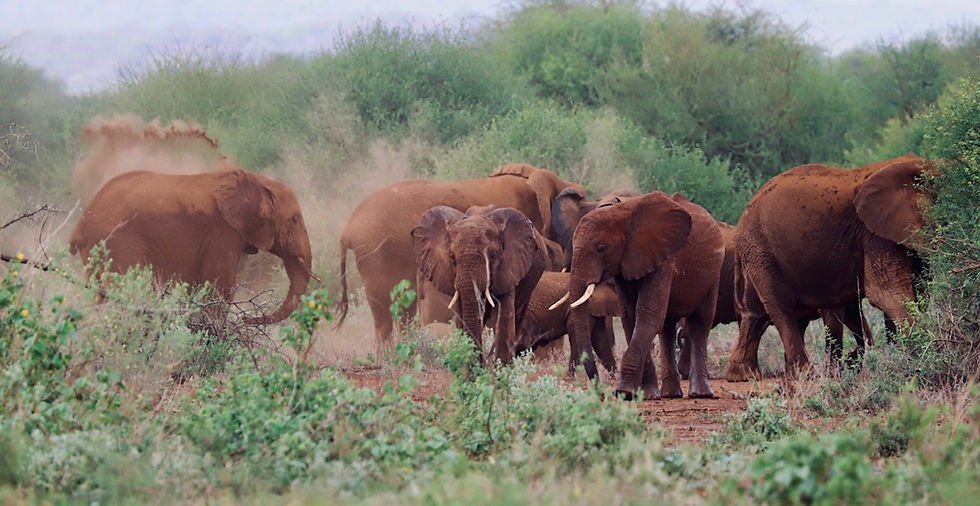
These two elephants didn’t fit the familiar image of Tsavo’s giants… the famous look of red-dusted elephants. These two had apparently been spending their time in the park’s northern riverine woodlands, where shade and seasonal rain-fed vegetation were abundant, providing a daily diet. Tsavo elephants are otherwise brick red, the color of the park itself, derived from iron-rich lateritic soils weathered from volcanic rock. For these elephants, dust clings to every fold and crease, giving them a look of dip-stained crimson. Something that emerges from a trip to Tsavo is that in other parks, elephants seem more to move through scenery, while in Tsavo, they wear it like a jacket. As such, Tsavo’s signature is less the elephant, but the color.
Night 1
Komboyo campsite is simple and functional, with a perimeter fence. (For Miles, his outside-the-wire campout would have to wait until the next day). The concentration of animals around the site is high with many elephants, zebra and buffalo on the other side of it, drawn by permanent water and grazing.
We pitched the same nylon tent we’ve trusted elsewhere. Miles helped the way kids often do: fully committed but mildly counterproductive, clearly distracted by the wonder of finally being in Tsavo. I’d talked it up to Miles pretty well over the preceding weeks, and now, here we were. We drove a bit more on the Chyulu circuit in the last light, then returned to wash up and watch stars.
By the end of December the short rains begin ease up, though occasional showers still linger in to early January. And with the tall grass of the campsite comes ticks, and, more consistently – wet or dry – tsetse flies, around but not in any overwhelming count. They’re a reminder of why people favor khaki and lighter shades: tsetse have evolved to key in on dark, high-contrast shapes that resemble the hides of large mammals. Darker colors equal food. Do remember that.
Day 2
That first morning back in the bush is always awesome. We broke camp and headed in the direction of the Chyulu campsite via the main route from park HQ to Mzima Springs and the Tsavo River. On several occasions, the road corrected my Land Rover’s suspension system, checking my confidence several times. I further deflated the tires and we pressed on. This time of year, the roads are a combination of mud from the short rains, rough basalt – both underneath and exposed – and, for sections longer than what's preferred, bone-rattling corrugation and long stretches of fractured lava gravel. Tsavo forces attention, and in some cases, a reroute. That came later on.
Moving ahead, a giraffe, zebra, oryx and a squadron of guinea fowl performed slow-motion games of chicken in the path in front of us. We reached Chyulu campsite, set up the tent, and drove out again through a refreshing rain shower to Mzima Springs, gliding along the soft, wet road as the sky ahead cleared above Mzima.
Mzima is a hallucination, a punchline to Tsavo’s rugged drylands, so much of which depends on underground rivers… clear water bursting from volcanic rock, a lush Tolkien-esque oasis tucked inside a much wider landscape of dry fire-built lava flows, rock and savannah. Fed by rainfall filtered for millennia through the porous lava of the Chyulu Hills aquifer, it feels more like an city jardin botanique than a Kenyan park.
Hippos were submerged in crystal clear water like boulders in an Oregon Cascade-Mountain river. In fact, at first glance I missed the hippos, thinking they actually were boulders. Miles had already figured this out, standing some meters away with hippos cross-haired in his binoculars.
From Mzima we drove to Poacher’s Lookout. The view is big, humbling, and with a name that carries one of Tsavo’s other stories: ivory, extraction, and a long battle of conservation and wildlife protection. Beauty and elephants have suffered consequences here, and the park’s loxodonta africana populations still carry that generational history in their age.

We stopped for a late lunch at Poacher’s Lookout, took in the view from above the savannah, then drove slowly back to Chyulu campsite with more elephants, giraffe, and distant pillars of rain pouring into the savannah, and headed our way from the direction of the Chyulu Hills. Storm systems often build along volcanic ridge lines, and we made it to camp about an hour before those rains caught up to us. We showered, and once settled into our camp, an hour of rain killed off hopes of a campfire. By 9:30 I capped off the day with a Tusker lager under a clear sky.
Chyulu campsite is large enough for nine, ten separate campsites. The thatched shelters, however, are wanting for repair, but the one we set up underneath was intact enough to keep us dry through the rain, save a few leaks.
Once in our bags, hyenas wandered nearby in the darkness and their mocking laughter felt more welcoming than anything else. This was Miles’ first true outside-the-wire camp, not a lodge, not a fenced compound, not a Hell’s Gate predator-free weekender. Just a tent, in a park that doesn’t bother with your own concerns. He fell asleep steady and calm, looking forward to tomorrow.
Leaving Tsavo
Morning arrived bright. We broke camp by 9 as I wanted to be into Voi by noon. There was a festival to reach, organized by Lulu Kitololo and several others, and Miles was looking forward to meeting up with two of his friends who were on their way from Nairobi. We drove the Chyulu Circuit one last time, through its woodlands and over drainage lines, and headed out toward Voi and New Year’s — Afri-Love Fest and music and people — a different scene after two nights of dust and elephants, but similar, too, in its pursuit of good spirits and homage to this great land.
Three weeks later, Tsavo red is still caked to the Defender’s underbelly and every crevice and crack inside that car holding onto its dust. I’ll leave it there for a while longer yet.
Campsites
There are several campsites in Tsavo West National Park. Since we camp in a ground tent, and I'm with my boy, I like to pick something in the middle of total wild and the controlled staleness of safety. I wanted to avoid Tsavo’s bushier wild campsites on the Tsavo River where permanent water attracts large predators and concentrations of warm-blooded food. Miles isn't quite ready for midnight big-cat visits – it’s a nylon backpacking tent, after all. While I’ve managed fine elsewhere (see the Marsabit post), I don’t want problems for Miles, or with his mother. So we stuck to the northern boundary of the park, Komboyo and Chyulu campsites.
Komboyo public campsite

Water, toilets, showers, designated cooking/bbq set-ups, maintained spots for ground tents, a perimeter fence, and a resident ranger, happy to open and close the fence when needed, providing a buffer between campers and tht nightly movement of elephants and buffalo.
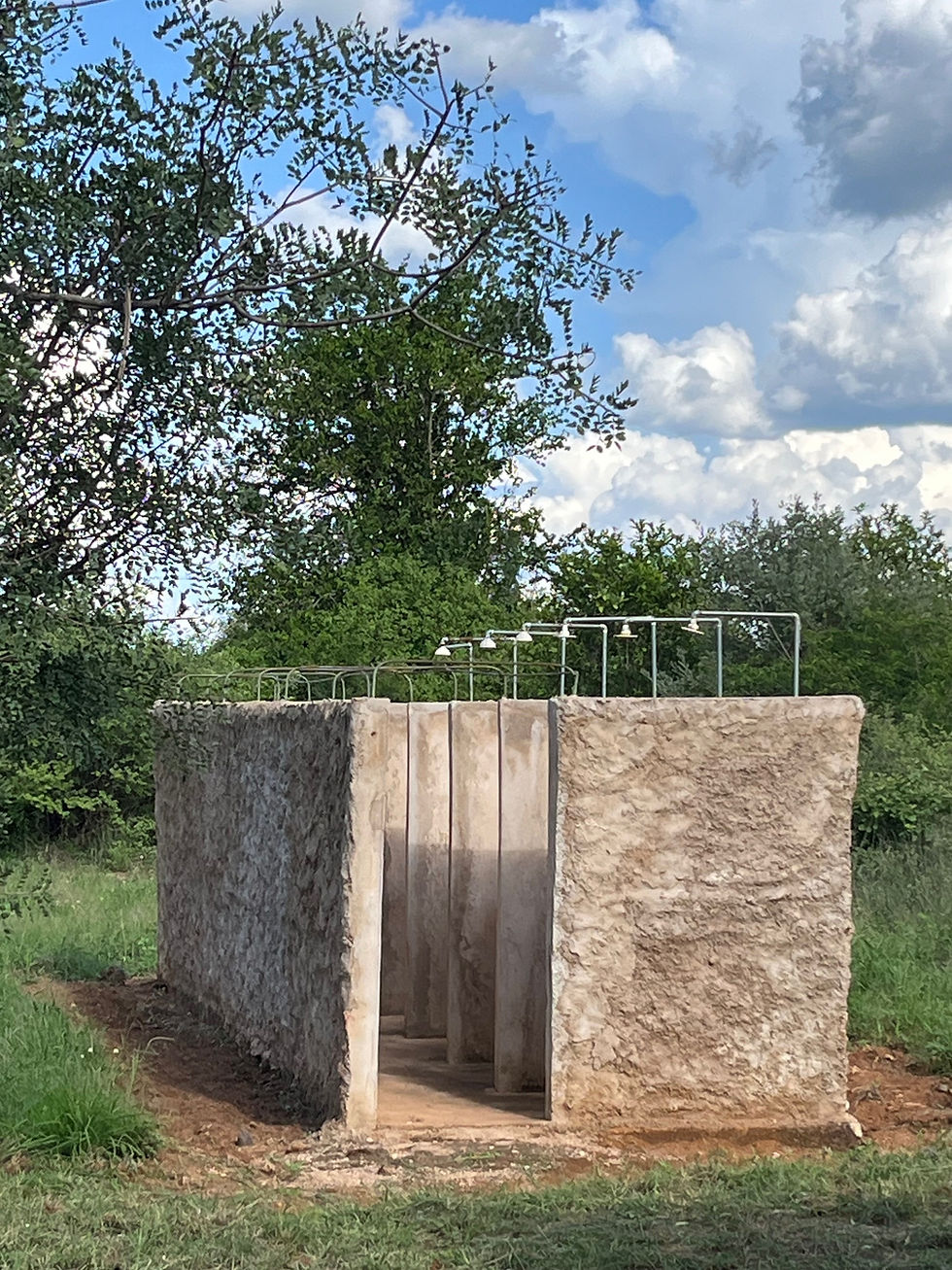
It’s about 20 minutes from the park’s HQ, inside the Mtito Andei Gate.
Chyulu public campsite
The best and smoothest route between Komboyo and the Chyulu site is the Chyulu Gate Circuit, and by far. The other route, just south and a principal track within the park, is corrugated and slow, especially with my old Defender, and cuts directly over exposed basalt and compacted volcanic gravel. It’s the corrugation that’s sucky. But the Chyulu Circuit route is half the time and a fun track. It was along this route, or a diversion just off of it, that we encountered those two bull elephants on day one.

The site: water, showers, toilets, fire pits, wood, some modicum of overhead shelter arrangements, but no perimeter fence. There’s a lodge nearby, and being well outside the regular hunting grounds of lions and other cats (lots of trees on this side), which tend to follow river corridors and denser prey herds. It’s a rather safe spot from any sudden surprises. Overall, it was a much more wholesome experience than Komboyo, and no tics and many fewer tsetse flies. The drive from Chyulu campsite to the main gate was just under an hour.
The KWS has published a great guide-book for Tsavo West which I highly recommend if you can find a copy. KWS has also published a pair of maps for both Tsavo West and East national parks. I picked mine up at the Text Book Centre at Sarit which has decent collection of Kenya park maps. There were no maps available at the ranger station at the gate, just an overpriced 12-page glossy of wildlife illustrations.




Tsavo West National Park Camping Guide | The Furrowed Elephant


Comments